Above the fold, above the noise
Redesigning a lender review experience to put user trust above business convenience.
INFORMATION ARCHITECTURE
COMPONENT DESIGN
SYSTEM THINKING
STAKEHOLDER ADVOCACY
Overview
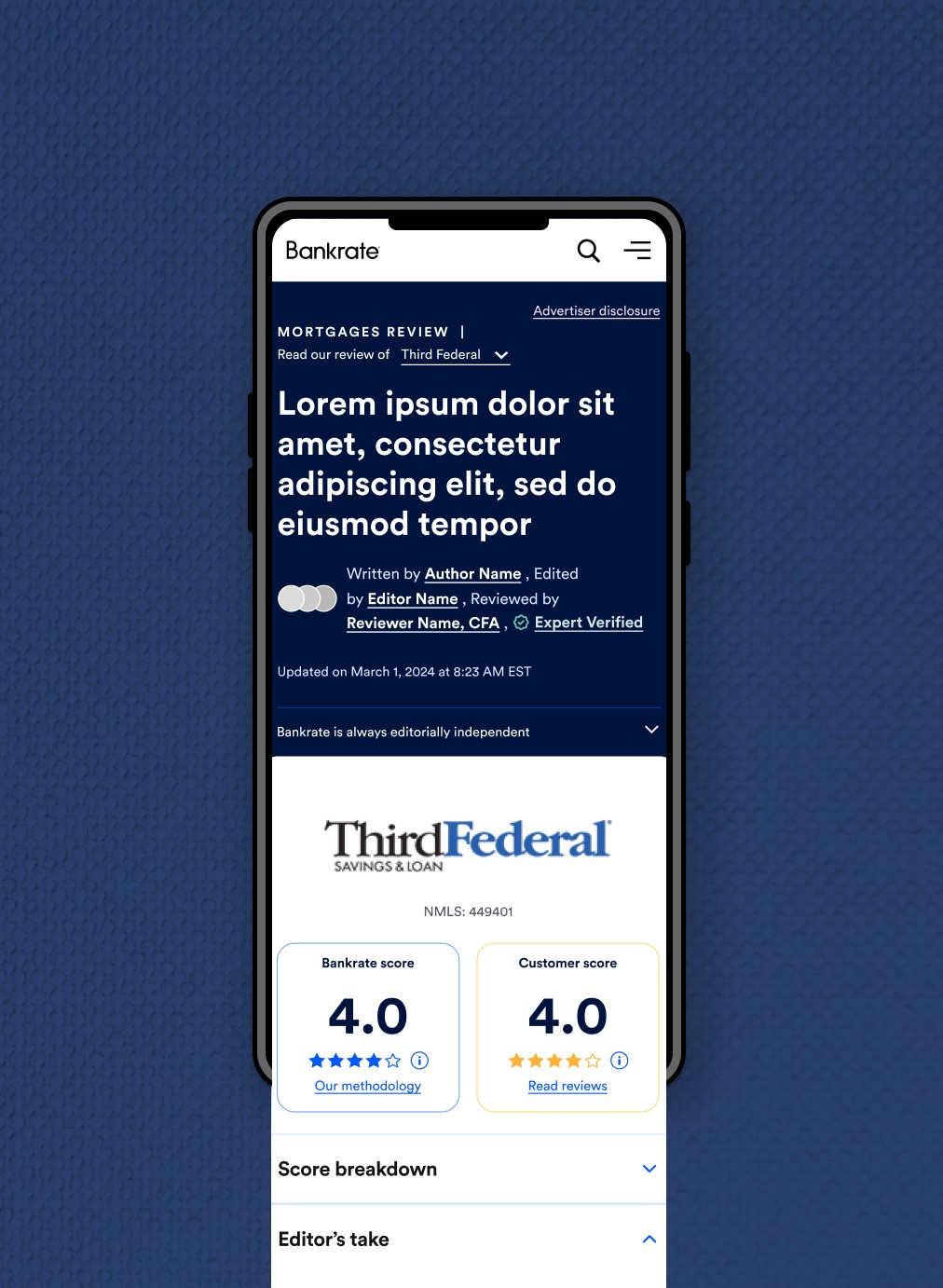
The Home Equity Reviews page had a clear goal: give users the most valuable context about a lender before they committed to scrolling through an entire article. Users arriving on a reviews page are in evaluation mode — they want a quick, trustworthy read on whether this lender is worth their time. The existing experience buried that answer deep in the page. This redesign brought it to the surface.
The initiative had two parallel tracks: redesigning the "At a Glance" experience above the fold, and establishing a scalable component foundation that other verticals across Bankrate could adopt without significant rework.
The Advertisement Problem
The biggest obstacle wasn't layout — it was a single component that stakeholders and SEO requirements insisted on keeping above the fold: an advertisement widget. Bold background, prominent CTA, supporting copy. Three elements fighting for attention at the exact moment users needed clarity most.
The widget didn't just compete visually — it consumed real estate that belonged to the user's decision-making process. In a space where trust and editorial authority were the whole point, an advertisement above the fold sent the wrong signal at the wrong moment.
I didn't just argue against it. I designed around it — repeatedly. Version after version showed the team what it looked like to try and make the widget work within the "At a Glance" card. Each iteration made the same thing clear: we were investing significant effort to force something into a space that was actively resisting it. The iterations became the argument. After working through the problem together, stakeholders agreed — what we were trying to do wasn't working because it fundamentally couldn't work. The advertisement was removed from above the fold.
That decision protected the user experience at a real cost to a business touchpoint. I'm proud of standing behind it with design evidence rather than opinion alone.
The Layout
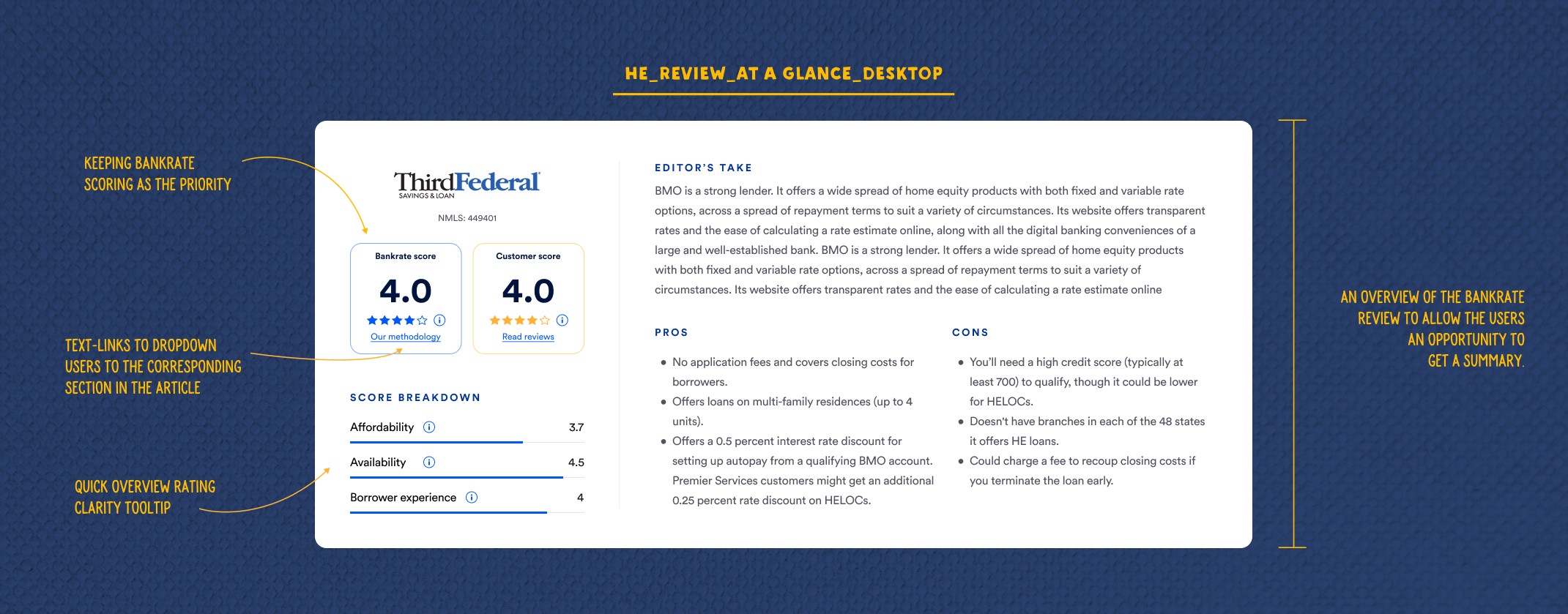
The final "At a Glance" design is clean, structured, and intentionally simple. The left side carries all the scoring and value signals — Bankrate score, customer score, score breakdown by category. The right side carries the editorial summary — Editor's Take, pros, cons. Two clear zones. Eye movement traces naturally from quantitative judgment to qualitative context without cognitive friction.
No advertisement. No competition for attention. Just the information a user needs to decide whether to keep reading.
Building for Scale
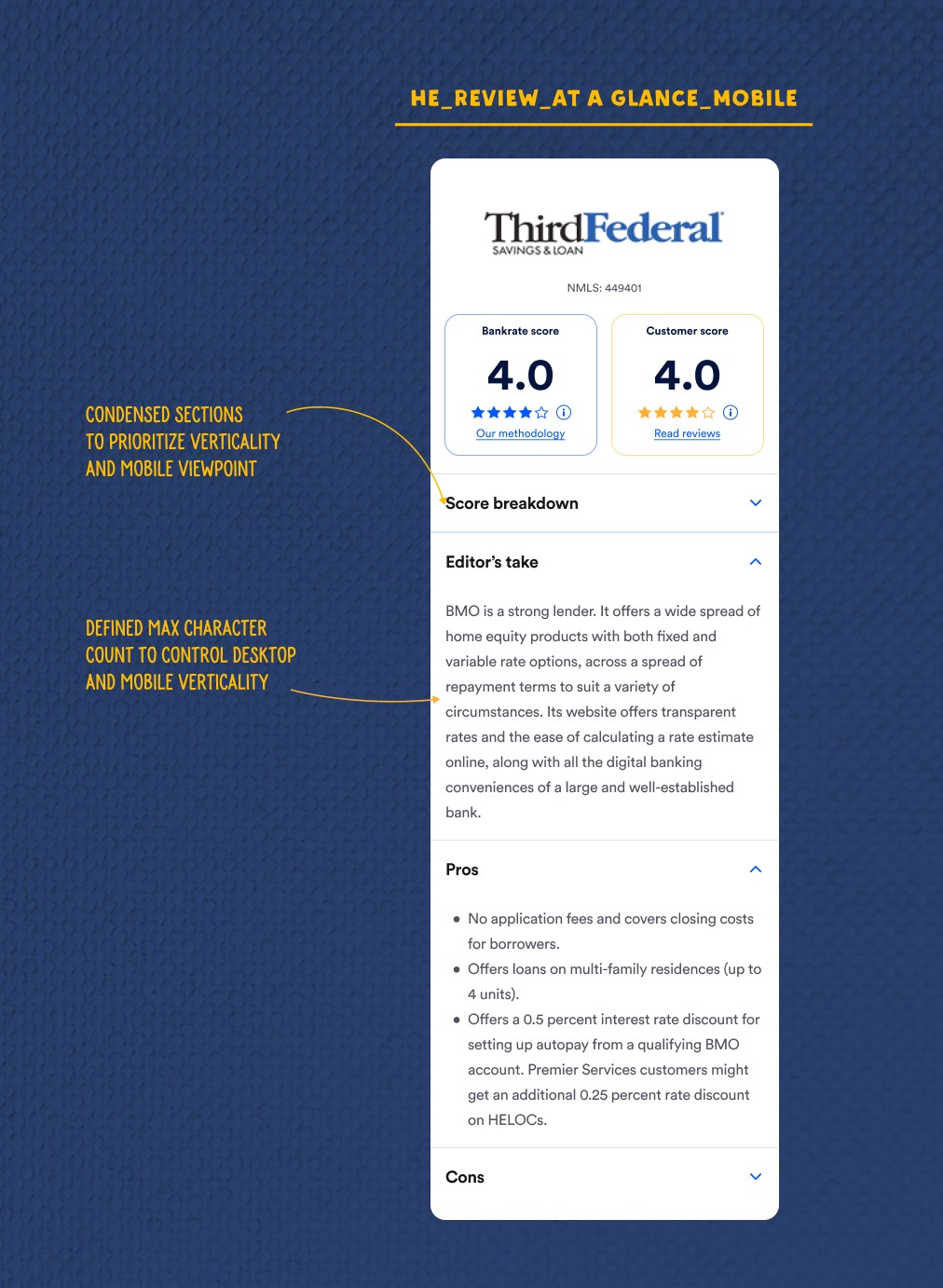
The second part of the initiative was systems-focused: establish a component baseline that other Bankrate verticals could apply without redesigning from scratch. Different verticals carry different value props — banking reviews surface different data than home equity reviews — but the structural logic should remain consistent.
My role was exploratory. I iterated through multiple variations, identifying what worked and what didn't, and templatized the final direction so other designers could build on it. A senior product designer took the foundation forward to completion. The contribution was the groundwork — proving the concept through iteration and leaving something usable behind.
Takeaway
This project reinforced two things. First, that the strongest design arguments are built from evidence, not preference — showing stakeholders why something doesn't work is more persuasive than telling them. Second, that designing for scale requires a different kind of thinking than designing for a single page. The decisions that feel small in isolation — how a component is structured, what content it accommodates — compound across every vertical that inherits them.

ROLE
ASSOCIATE PRODUCT DESIGNER
COMPANY
BANKRATE
TOOL
FIGMA