
Case Study// Pre Big Swing
Back to Summary
A redesign that turned friction into trust – proven with data
PRODUCT DESIGN
UX STRATEGY
STAKEHOLDER ALIGNMENT
DATA-DRIVEN DESIGN
USER RESEARCH
Overview
The PRE (Pre-Rate Experience) is the content a user encounters before reaching the mortgage rate table — originally introduced in 2021 to satisfy Google's E-E-A-T guidelines and make the experience feel less transactional. It worked: the pages regained top search positions and grew to represent 78% of earned rate table sessions and 63% of earned revenue across the mortgage vertical.
But by 2025, the landscape had shifted. Transactional search share of voice had declined significantly as Google began favoring AI-generated overviews and simpler brand experiences. The PRE that once protected rankings was now creating friction for the users it was meant to serve.
Pre Big Swing was the initiative to fix that — not just visually, but fundamentally. I was brought on as the design lead to reimagine what PRE could be, balancing user needs, SEO constraints, and business goals across one of the platform's highest-traffic surfaces.
The Problem
The existing experience forced users through a two-click journey before reaching actual mortgage rates. The PRE itself was content-heavy by design, providing educational context about mortgages before surfacing the rate table. While that served first-time shoppers, it created unnecessary friction for the majority of visitors who already knew what they wanted.
Despite having clear CTAs at the top of the page, users still had to scroll through dense content and take an extra step to reach rates. Meanwhile, the broader page structure created a disconnect: the landing experience catered to learners, but the rate table catered to doers — and neither did both jobs well.
The business context added urgency. With transactional SOV declining through 2025 and competitors like Freddie Mac and US Bank offering simpler, rate-forward pages, the PRE wasn't just a UX problem — it was a competitive one.
Goals
The goal of PBS wasn't to iterate on what existed — it was to rethink what the PRE should actually do. Concretely, the team aligned on three success criteria:
Increase user engagement — measured through element tracking, time on page, and bounce rate
Increase conversion — measured through CTR, CTL, and RPS
Increase organic traffic — measured through sessions and share of voice
One constraint was explicit from the start: the rate table itself and content below the fold were out of scope. This was a PRE redesign — and a chance to take a genuine big swing at it.
Prior Testing Context
PBS didn't happen in a vacuum. The team had been iterating on PRE for years, and that history informed every design decision I made.
Earlier tests gave us a foundation to build from. Version 1 — a dark-mode redesign — produced unexpected wins, with lead form completion up 9% over control and mobile RPS up 11%, largely attributed to improved spacing. It was hard-coded as the new baseline. Version 2 tested daily rate ticks above the fold but proved too volatile: engagement swung based on whether rates moved up or down that day, making it impossible to predict performance. Version 3 showed that what wins for SEO traffic doesn't always win for direct traffic, and vice versa — a split that would inform how I thought about designing for multiple audience types.
The audience data from prior analytics reinforced the challenge. On the main rate table, 63% of sessions came from high-engagement users who responded to trust signals and incentives, while 21% were active information seekers who wanted research tools. On secondary pages, 65% of sessions were engaged decision-makers — predominantly mobile — who explored before committing. The data pointed clearly toward a need for personalization, social proof, and content diversity.
Design Exploration
I began with a broad exploration alongside the creative and business teams — competitive research, open ideation, and alignment on what directions were worth building out. From that foundation, I identified two primary user types the redesign needed to serve:
Explorers — first-time or early-stage mortgage shoppers who need guidance, context, and trust signals before they're ready to act
Experts — returning or high-intent users who know what they're looking for and want rates immediately
To test which approach better served overall user intent, I developed two distinct design directions alongside the live controlled experience:
Intent-led design — A guided, form-first experience that collects loan type, credit score, home price, and down payment upfront. Answering these questions dynamically filters results, making the experience feel tailored rather than generic.
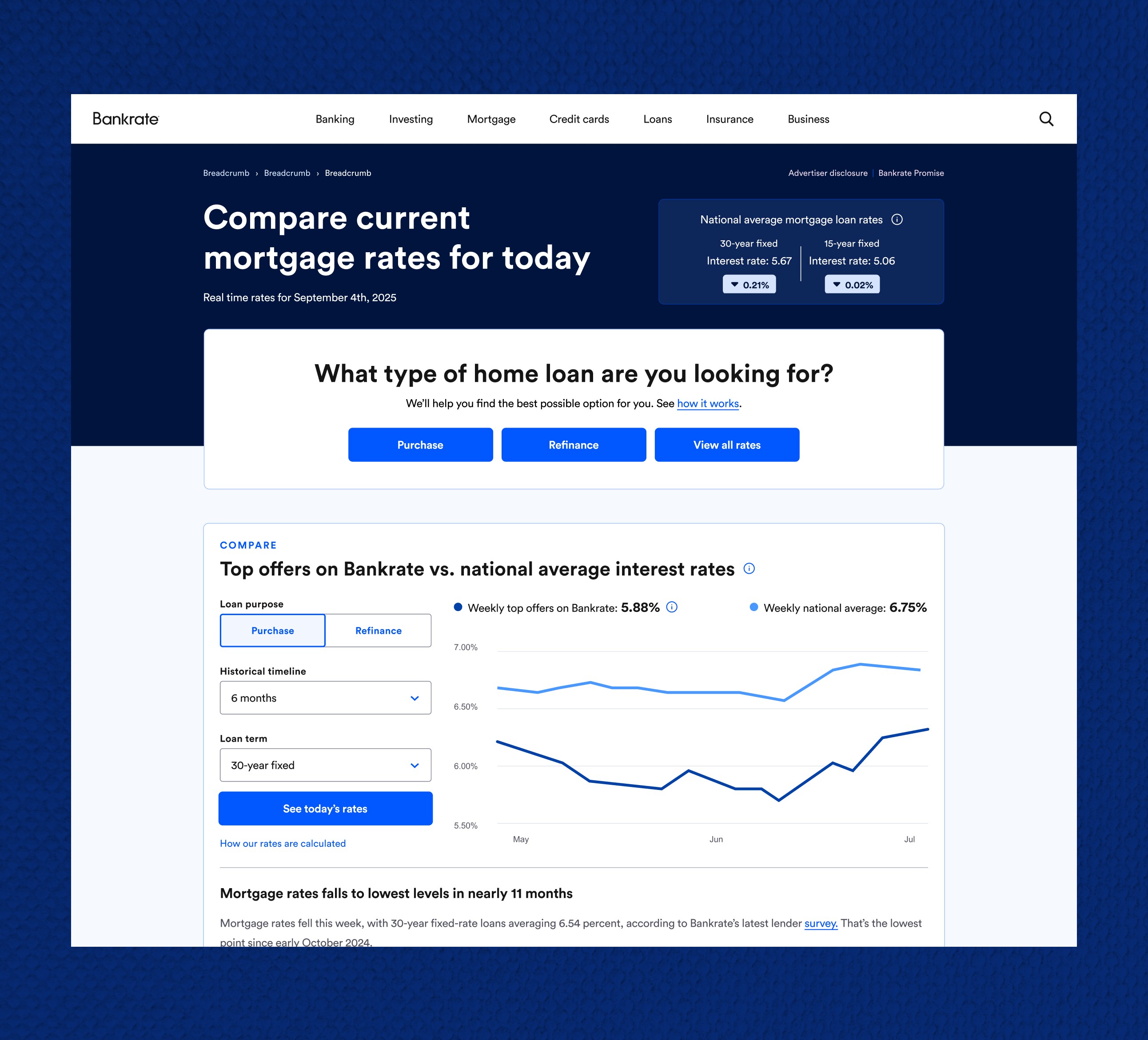
Rates-led design — Rates surface immediately on page load, with daily figures and week-over-week movement visible above the fold. Supporting context and personalization tools are available below for users who want to go deeper.
Each concept intentionally emphasized one audience's needs — personalization for Explorers, immediacy for Experts — so we could test whether one approach dominated or whether the answer was somewhere in between.
Intent Led
Rates Led

Should users get the opportunity to personalize the rates they see prior to seeing any?
Version 1
Version 2
Version 3
Version 4
Navigating Misalignment
Once the two designs were in development, a tension surfaced that I hadn't anticipated at the start. The rates-led design — which surfaced rates within a single scroll on both desktop and mobile — raised concerns from the SEO team. Their worry: presenting rates too prominently could signal an overly transactional page to Google's algorithm, potentially eroding the search rankings the PRE was originally built to protect.
This was a real conflict. The CE team saw the design as a valuable experiment. The SEO team saw it as a risk. And at the center of it was a question leadership hadn't fully answered yet: were we trying to innovate, or were we trying to protect?
I used the designs themselves to move the conversation forward. Rather than letting the debate stay abstract, I walked stakeholders through the reasoning behind each direction, explained what we could and couldn't know without data, and made the case that testing was the only way to answer definitively. That shift — from speculation to curiosity — was what ultimately got everyone aligned on testing all three designs.
Research and Testing
Testing was conducted through Userlytics in August 2025 with 101 external participants (51 desktop, 50 mobile) and 20 internal users, all screened for some experience or active interest in mortgage rate shopping. Sessions were 15 minutes each, qualitative and quantitative in nature, and I used AI-assisted synthesis tools to identify themes efficiently across the volume of feedback.
A follow-up unmoderated study with 10 additional users was conducted to isolate a specific question: were users drawn to the rates-led experience because of the rate content itself, or simply because the rate table was closer to the top of the page?
Control
Intent Led
Intent Led

Rates-led design: rates surface immediately on load, optimized for high-intent users who know what they want
What we found:
The rates-led experience earned the highest trust scores across the board — approximately 55% of desktop testers named it the most trustworthy option, and ~76% said the rates section stood out most. It was the clear favorite for high-intent users actively looking or planning to get a mortgage soon.
The intent-led experience performed strongest on mobile — winning overall preference and trustworthiness votes in the internal survey — driven by its balance of personalization, visual clarity, and guided flow. Users valued feeling like the experience was built around their situation, not a generic starting point.
The controlled (live) experience held up best for early-stage users who appreciated the explainer content and approachable layout. But it consistently fell short for anyone with active intent, and only 14% of desktop testers said rates stood out — the lowest of the three options.
The unmoderated follow-up confirmed that users weren't just responding to proximity — it was the presence of actual rate data that drove preference for the rates-led design, not just its position on the page. That distinction mattered for how we thought about the final solution. In fact, when users were shown the two new concepts side-by-side in a structurally equivalent comparison — across both desktop and mobile — the rates-led experience dominated: 100% of participants preferred it overall, 100% rated it most trustworthy, and 80% said rates stood out most. The one area of split was rate visibility on mobile, where 40% of participants favored the intent-led layout — a finding that directly validated the hybrid direction of the final design.
Final Direction
The research made one thing clear: neither concept alone was the answer. Immediacy built trust. Context built confidence. The final design had to do both.
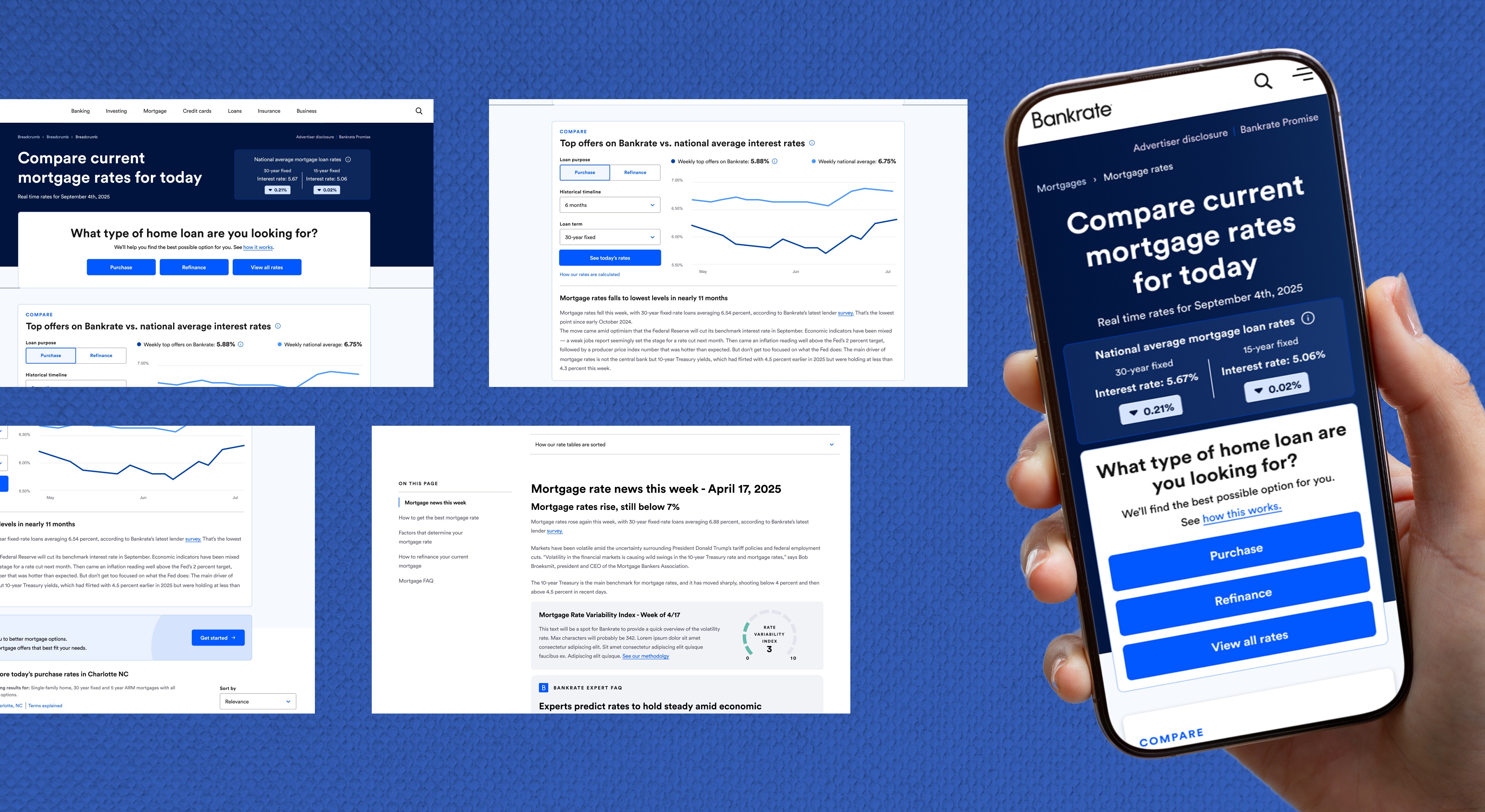
Drawing from the strongest elements of each direction, the merged solution leads with rates — surfacing daily mortgage rate data at the top of the experience — while layering in guided personalization below the hero to help users drill down to rates relevant to their situation. The historical rate graph, which tested poorly in isolation (users found it confusing without framing), was deprioritized in favor of contextual cues that gave numbers meaning without requiring users to interpret a chart on their own.
The result was a single experience that could serve both user types without forcing a choice. Explorers get enough scaffolding to feel confident. Experts get the data they came for without navigating past it.
Outcome
The PBS design was built, launched as a live A/B split test, and delivered measurable wins across every meaningful conversion metric — even under difficult conditions. The test was paused after one week due to organic ranking volatility, but the early results were decisive.
Metric
PBS Variation
Delta vs. Control
Revenue Per Session (RPS)
$1.17
+5%
Clicks to Lead Conversion Rate (CVR)
34.4%
+8%
Click Through Rate (CTR)
1.51%
-3%
Revenue Per Lead
$225.30
Flat
The pattern tells a clear story: overall click volume dropped slightly, but the users who did click were significantly more qualified. The +8% lift in conversion rate and +5% RPS gain outweighed the CTR dip — proof that a more informed user is a more valuable one. Total revenue during the test period came in at $73K, up 4% over control.
Two component-level wins reinforced the structural decisions made during design. Replacing dropdown loan type filters with high-visibility buttons drove a +54% increase in filter engagement, reaching 3.2% CTR on those elements — validating the assumption that surfacing choices visually rather than hiding them behind a dropdown would drive action. The "See today's rates" CTA within the rate trends module saw a +5% lift, confirming that users prefer a scrollable, data-rich experience over a gated entry point.
The test was ultimately paused and the experience reverted to the original while SEO and product teams worked through a path forward on rankings. Following an organizational restructure, I transitioned off the project before a full relaunch — but the foundation I built remained intact. The final live experience reflects the design system, structural decisions, and UXR-backed direction I established, carried forward with minor refinements by the team that inherited it.
Impact summary:
+5% RPS and +8% CVR in live A/B testing, with $73K revenue (+4% vs. control) in one week
+54% lift in loan type filter engagement after replacing dropdowns with visible buttons
+5% lift in "See today's rates" CTA engagement within the rate trends module
UXR sweep: 100% of follow-up study participants preferred the new design and rated it most trustworthy across desktop and mobile
Primary study: ~55% of external testers named the rates-led experience most trustworthy; ~76% said rates stood out most
Unified SEO, CE, and creative stakeholders around a shared testing framework — and a design direction that held through an organizational transition
Reflection
Design as alignment tool. The most important design work in this project wasn't in Figma — it was using designs to move conversations forward. When stakeholders disagreed about risk and ambition, the prototypes created a shared object to react to. Clarity came from showing, not arguing.
Protecting scope without losing ambition. The scope of PBS expanded significantly from its original brief. Keeping the work focused while still pushing for something genuinely new required constant communication — with leadership, with the SEO team, with peers. Ownership isn't about having authority; it's about staying accountable when things get complicated.
Testing earns permission. The decision to test all three designs — including the one that made some stakeholders nervous — came from making a clear case for what real data could provide that assumptions couldn't. That's a pattern worth repeating.





ROLE
ASSOCIATE PRODUCT DESIGNER
TIMELINE
Q3 (6 WEEKS)
TOOLS
FIGMA
USERLYTICS
FIGJAM
CHATGPT + CLAUDE